Pages

Search This Website

Wednesday, July 20, 2022

India’s 10 Best Selling Newspapers of Hindi and English 2022

 India’s 10 Best Selling Newspapers of Hindi and English 2022


As an Indian, one’s day is incomplete without flipping via  the pages of the newspaper in the morning, while sipping on hot morning tea.
Newspapers can be narrated as one of the oldest ways of print media communication. It is not only a mean of details but, it even equips readers with rewarding knowledge pertaining to education, entertainment, health, lifestyle, finance and real estate. Not to forget, it even functions as a ‘watchdog’ of the Indian society. Do you know?

The first Indian newspaper was issued under the colonial rule on 29 January 1780 by James Augustus Hicky. It was a called ‘The Bengal Gazette’. It only had 2 very small sheets and was filled with lots of advertisements.

Since then the country has come a long way, India has emerged as the 2nd -largest newspaper market in the world, with over 100 million copies of newspapers sold per day.

English Newspapers


It is one of the most famous Indian English-language daily newspaper. The newspaper was established by philanthropist, Sardar Dayal Singh Majithia on 2nd February 1881, at Lahore. Majority of its readership includes 

The North Indian population belonging to the states of Punjab, Himachal, Haryana, and Chandigarh. At current , the newspaper is issued from the following cities- Chandigarh, New Delhi, Jalandhar, Dehradun, and Bathinda.

The organization functions as a trust with 5  persons as trustees. Justice S. S. Sodhi is the President of the platform Trust. The newspaper is obtainable offline also  online mode, too.

Times of India


Doubtless , one of the most sensational English-language regular paper. A holding of The Times Group, this news regular is the fourth-biggest paper in the India in terms of rotation and highest selling English-language daily in the entire world. (Source: Audit Bureau of Circulation) The publication marked its launch  in the year 1838 and has become one of the earliest English-language newspaper existing in the nation.

It is direct  by the Mumbai-based media company, Bennett Coleman & Co Ltd (BCCL) and is issued from over 36  cities across the nation. Jaideep Bose is the present editor-in-chief of the daily and earned an impressive net income of $190 million dollars (2016)

The Indian Express


Grabbing the 3rd spot on this list of the best English newspapers of the India is The Indian Express. The newspaper was established some 87 years ago by Ramnath Goenka in the year 1931. Post Goenka’s d the organization was distributed among the family members.

The southern publications started utilizing the name ‘The New Indian Express’ whereas the other editions, headed by Mumbai office kept the opening Indian Express name but added ‘The’ as a prefix to the title. According  Indian Readership Survey, it emerged as the 3rd most famous English daily in the nation. Recently , the newspaper is issued from 10 cities and mentions Mumbai as its head office.

The Hindu


Another leading English regular is The Hindu. It enjoys a large amount of readership all around the south India. Its headquarters are situated in the Chennai, Tamil Nadu. The newspaper initially started out as a weekly in the September 1978 and later on, went on to become a daily publication in 1889.

The leading newspaper is owned by a family-held firm, Kasturi and Sons Ltd. Even , it was one of the very 1st publications that rolled out its digital edition in the 1995.According  a 2017 survey, it is next in line to TOI as one of the most widely sold English newspaper of the nation , with a declared sale of over 1.2 million copies per day.

Hindustan Times


It is another newspaper which was established during the pre-independence era. Roots dating back to 1924, it was started by the pioneer  of Shiromani Akali Dal, Sunder Singh Lyallpuri, in the Punjab. At current , the regular is headed by Congress Rajya Sabha M.P. Shobhana Bhartia and is, therefore, known for taking a pro-Congress stand.

The newspaper is a part of HT Media, which is further arrange by the popular Birla group. Sukumar Ranganathan is its present editor-in-chief. It even features weekly columns from renowned journalists such as Barkha Dutt, Karan Thapar, Indrajit Hazra and many more. Its offices are spread all around many locations such as New Delhi, Chandigarh, Mumbai, Kolkata, Lucknow, Patna and Ranchi.


Hindi Newspaper (हिन्दी समाचार पत्र)


Dainik Jagran (दैनिक जागरण)


Positioned as number 1 on the list, Dainik Jagran is one of the most widely read newspaper in the nation and the biggest newspaper circulated in the India as per to the Audit Bureau of Circulations. Its roots date back to the colonial period and was pioneer by a three-member team of -Shri Puran Chandra Gupta, JC Arya, and Shri Gurudev Gupta.

Its 1st publication dates back to 1942 in Jhansi. It has received recognition at the global level and has been declared as one of the most read newspapers by World Association of Newspapers (WAN) and even , as the most trustworthy newspaper in a survey by BBC.

Dainik Bhaskar (दैनिक भास्कर)


It is the second-highest circulated Indian Hindi-language regular newspaper. Established in 1948 as Subah Savere in Bhopal and a decade later, it was renamed to Dainik Bhaskar.

The newspapers headquarters are situated  in Bhopal and is headed by Dainik Bhaskar Group (D B Corp Ltd), the biggest print media company in the nation . It’s regional publication houses are present in 14 states, 63  editions in languages such as Hindi, English, Marathi, and Gujarati. Last year in June 2017, the broadsheet newspaper introduced it’s Hindi News Apps for three various operating systems i.e. Android, iPhone, and Windows

Amar Ujala (अमर उजाला)


It is another leading Hindi-language daily newspaper issued in the country. The broadsheet newspaper was established in Agra in the year 1948. It boasts of 19 editions reaching out to 167 districts, 7 states, and one union territory. It even revealed a rotation of around two million copies.

Its daily problems often comprise a 16- to 18-page issue with additional supplements pertaining to areas such as jobs, careers, lifestyle, entertainment, and women related areas. It is direct by Rajul Maheshwari. The newspaper has its headquarters at the Noida and is even , obtainable in digital format.

Sach Kahoon (सच कहूँ)


“Sach Kahoon Hindi” is a chief national newspaper in North India. This newspaper is in the panel of vital media bodies, DAVP, DIPR and INS.

It is pertinent to tell that this Newspaper is decided one among most read newspapers in the states of Punjab and Haryana. It is run and controlled by Sajag Media Publication and its head office is situated in Sirsa (Haryana).

It publishes many editions in Punjabi and Hindi languages.

The Media House boasts that its regular Print and Digital (Online) version garners more than 10 lakh readership around the globe against rotation of 3.40 lakh odd copies (readers from several Indian states like  Punjab, Haryana, Rajasthan, Uttar Pradesh, Uttarakhand, Delhi, Chandigarh and overseas nations contains Canada, Australia, New Zealand and Middle East).

Follow the below described web links for its Hindi & Punjabi languages, Epaper: http://epaper.sachkahoon.com/

Hindustan


Popularly known as Hindustan Dainik, it is the third-largest Hindi-language daily newspaper in the India. It initiated on 26th April 1936 and is known for its centrist political alignment. In locations such as Delhi and NCR, it has grabbed the 2nd rank in terms of readership.

Earlier, it was a part of HT Media Ltd group, which turned its Hindi venture into another company called Hindustan Media Ventures Limited in December 2009. It has 21  editions and boasts of 2,399,086 copies daily. All its editions are obtainable online.

Read More »

Friday, July 15, 2022

Patan Patola, the cloth of kings

 Patan Patola, the cloth of kings


Two fluorescent bulbs cast harsh shadows on the peeling walls of the cramped workshop in the Patan, a town in India’s Gujarat state. 8 workers sit inside, silently focused on the tasks at hand: carefully wrapping and unwrapping thousands of dyed silk threads.


A middle-old man, Mr. Soni, stands at the center of it all, a master observing over his craftsmen. And watch he must: if 1 mistake is made, the procedure  must begin all over again. Such is the art of Patola, the India’s most complex textile.


Patan Patola: cloth of kings

The complexity and time-intensiveness is what creates Patola so valuable. A dazzlingly mathematical procedure , Patola saris are woven utilizing dyed threads both vertically (warp) and horizontally (weft) to make the design. The strings are dyed as per to a pattern, and the dye marks align when woven, forming the pattern on the cloth.

For each color in the design, workers tie sections of the silk threads with cotton string until only the parts to be shaded remain exposed. The entire bundle of threads is then soaked in dye, before the cotton strings are torn off to reveal the un-dyed portions. Rinse, repeat, until the threads are all shaded to match the pattern.

The wrapping and dyeing procedure  for just one color takes a week, and doing all the colors takes one or two months. Mr. Soni say us how, from start to finish, designing and making one saree takes minimum  seven months.

Our jaws hit the floor, but it’s standard process for Mr. Soni. To put things in perspective, he says us the most difficult sari they ever made took 2.5 years. But the cost tag on a Patola sari justifies the days of painstaking work: one custom-made sari begins at 150,000 rupees, about $2,250.

After watching the workers nimbly tie and untie threads for 1/2, we’re chomping at the bit, excited to watch everything come together in the weaving rooms. But Mr. Soni guides us away from the workshop instead.

He insists we create a quick stop before he reveals the rest of his workshop’s secrets. “It’s vital , first, that you understand the story of Patola.”


The history of Patan Patola

The story starts more than 900 years ago, with a king named Kumarpala.

The majesty had a passion for Patola, one of the most luxurious textiles in the world. Woven so nice that the front and back are indistinguishable from each other, and a colorful feast for the eyes, they were honestly the cloth of kings, and the ultimate symbol of wealth.

Kumarpala was specific about where and when he donned his Patola. A patron of Jainism, he required to be clean and dressed in fresh clothes before saying prayers at the temple. In a display of extreme piety (… or royal indulgence), he insisted on wearing only Patola when going to temples.

Initially, his Patola supply came from Jalna, a city in neighboring the Maharashtra state. That screeched to a halt once Kumarpala learned how the king in Jalna utilized Patola as bed sheets before selling or gifting them to other aristocrats in the area. The Jalna king’s ego aside, what type of king knowingly wears the bed sheets of another?

The royal trouble was resolved in a suitably royal fashion. Furious and decided to have an untainted supply of Patola, King Kumarpala brought 700 Patola craftsmen and their families to Patan, Gujarat, from the Maharashtra and Karnataka states. It’s told that he then staggered production, and despite the 7+ months manufacturing time of Patola, he received at least 1 new Patola to wear to the temple every day.

Patola now

In the 900 years since Kumarpala’s reign, the traditional patterns and practices of Patola creating are still alive in Patan. To support us understand how engrained the traditions honestly are, Mr. Soni leads us to Rani Ki Vav, an 11th century step well outside of Patan.

To be honest, Patola is the last thing on my mind upon laying eyes on the step well—it is, to say the least, absolutely crazy.

7 flights of stairs lead down into the four galleries of the well, once used for the masses to collect their water. Though time has smoothed some, all surface was once intricately carved with patterns or reliefs. Dozens of statues of voluptuous dancers obtaining dressed decorate one of the walls, while other walls are more divine in nature, showing the various incarnations of Vishnu.

Walking along the statues of dancers and royals and gods, he describes the historical significance of each curve and edge, before stopping in front of a series of the square patterned plates carved into the walls.

Compared to the rest of the graphic step well adornments, they seem almost painfully dull upon 1st glance. My eyes start to wander back to the graceful dancers and parading elephants, when Mr. Soni approaches out and brushes the plates with his hand.

Their symmetrical designs are based on the divine situations of the stars, he explains. Impressive offered they’re almost 1,000 years old. More amazingly, these are the patterns of those Patola made before 900 years … and the patterns that are still utilized today. These traditional designs are what create Patola, Patola.


Patola of the future 


And Mr. Soni honestly  is a master: despite the numerous people working in each room, Mr. Soni and his son are the only 2 people in the company that know the whole Patola procedure.

In all of Patan, only 2  families of the original 700 still make Patola: the Sonis and the Salvis. The Sonis are open about what they do, but the Salvis are tight-lipped about what goes on within their a workshops. They even refuse to pass down the knowledge to anyone but their sons.

So does this mean the art of Patola will finally die? Mr. Soni hopes not. Realizing the importance of tradition, he works together with his son to both bring in fresh blood to the business, and improve Patola’s reach in the world. Some of their Patola have been provided to museums, while his son, Shyam, incorporates Patola fabric into more modern clothes and accessories.

Unlike the Salvis, the Sonis open to teaching parts of the Patola-making procedure  to those not native to Patan, so long as they are hard-working and willing. But potential heads  are in much shorter supply. Exploring someone competent enough to wrap their minds around the highly mathematical designing and dyeing procedure is no easy task, and so the father and son remain the gatekeepers of the knowledge. For now.

There’s a Gujarati telling , “Though it may suffer wear and tear, a Patola’s design will never vanish .”


Read More »

Thursday, July 14, 2022

IND vs ENG: India beat England by 49 runs in the second T 20

 IND vs ENG: India beat England by 49 runs in the second T 20


India vs England, second T 20 Highlights:

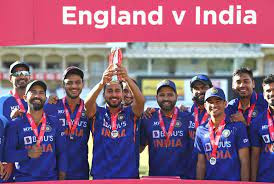
                India beated England by 49 runs in the second T 20 International to take an unassailable 2-0 lead in the three-match series on Saturday. Sent into bat, India arranged a decent 170 for eight. Ravindra Jadeja top-scored for India with an unbeaten 46 off 29 balls, while skipper Rohit Sharma hit a 20-ball 31 and Rishabh Pant created 15-ball 26. Chris Jordan (4/27) was the pick of the bowlers for England, while Richard Gleeson (3/15) snared 3 wickets on debut.

Chasing, England kept wickets at daily intervals to be bowled out for 121 in 17 overs. Moeen Ali made 35 off 21 balls for England and was the highest scorer, during David Willey scored unbeaten 33. Bhuvneshwar Kumar (3/15) picked up three wickets for the India, during Jasprit Bumrah (2/10) and Yuzvendra Chahal (2/10) scalped 2 wickets apiece. India had earlier beated England by 50 runs in the first T 20 I at Southampton.

Brief Scores:

India: 170 for 8 in twenty overs (Ravindra Jadeja forty six  not out, Rohit Sharma 31; Chris Jordan 4/27, Richard Gleeson 3/15).

England: 121 all out in seventeen overs (Moeen Ali 35; David Willey 33; Bhuvneshwar Kumar 3/15, Jasprit Bumrah 2/10, Yuzvendra Chahal 2/10).

Follow highlights of IND vs ENG from Edgbaston below.

Match Ended
India tour of England, 2022 - 2nd T20I

England

121 (17.0)
vs

India

170/8 (20.0)
Match Completed  ( Day - 2nd T20I )
India beat England by 49 runs

LIVE BLOG

IND vs ENG 2nd T 20 Highlights: Catch all the live-action between India vs England from Edgbaston, Birmingham.

22:19 (IST)09 JUL 2022
   
ENG vs IND 2nd T20 Live: India win by 49 runs

Harshal Patel in to bowl the 16th and Wiley hits a 6. Almost a catch but England won't mind. A full stop next which is sliced away for 4 more. And out!!! India win by 49 runs. They clinch the series 2-0.


Read More »

Wednesday, July 13, 2022

List of National Security Advisor in India

  List of National Security Advisor in India


The post of National Security Advisor (NSA) of the India is among the most powerful bureaucrats in the Government of the India. The post of NSA was first made in November 1998. The person appointed as the NSA mostly belongs to the Indian Foreign Service or to the Indian Police Service; depends on the discretion of the Prime Minister of the India.


Vikram Misri, former China envoy chosen as Deputy National Advisor (Dy NSA) in the National Security Council Secretariat. He will report to the National Security Advisor Ajit Doval.

The National Security Advisor (NSA) is the senior official on the National Security Council (NSC) of the India. NSA is the Chief Advisor to the Prime Minister of the India on national and international security policy. Presently , Ajit Doval is the present NSA; he is pursuing his 2nd term and obtains the rank of Cabinet Minister in the current NDA government.

Before Ajit Doval; there were four persons have been appointed to the post of National Security Advisor. Mr. Brajesh Mishra; an Indian Foreign Service officer was the first national security officer in India chosen  by the former PM Atal Bihari Vajpayee in November 1998 who remained in office till 22 May 2004.


List of National Security Advisor 

Name

Tenure

Prime Minister

1. Brajesh Mishra (IFS)

November 1998 to 22 May 2004

Atal Bihari Vajpayee

2. J. N. Dixit (IFS)

23 May 2004 to 3 January 2005

Manmohan Singh

3. M. K. Narayanan (IPS)

3 January 2005 to 23 January 2010

Manmohan Singh

4. Shivshankar Menon (IFS)

24 January 2010 to 28 May 2014

Manmohan Singh

5. Ajit Doval  (IPS)

30 May 2014,  Incumbent

Narendra Modi

The appointment of the NSA is approved by the Appointments Committee of the Cabinet (ACC). This committee is headed by the Prime Minister of the India.

Functions of National Security Advisor

The National Security Advisor (NSA) advises the Prime Minister of India on all matters relevant to external & internal security threats to India.

The National Security Advisor (NSA) gets all intelligence reports and presents them before the Prime Minister. The NSA takes part in directing strategic and sensitive matters  on behalf of the Prime Minister of India.

The NSA of India even serves as the Prime Minister's Special envoy with China also  Pakistan and Israel on security affairs. You must have seen NSA companion  the Prime Minister on official foreign and State visits.

The current NSA of India; Ajit Doval is provided the rank of Cabinet Minister.

So, this was the full list of National Security Advisors of India. We hope that list of NSA is very pivotal for many competitive exams; hence students require to remember it thoroughly.

Read More »